 12 mins read
Global IoT deployments are complex. Enterprises face challenges like fragmented coverage, roaming restrictions, and the burden of managing multiple SIM SKUs.
Traditional SIM cards fall short in addressing these issues. This is where eUICC comes in.
eUICC, or embedded Universal Integrated Circuit Card, enables a single eUICC SIM to host multiple operator profiles and switch between them remotely.
This capability transforms IoT deployment by eliminating the need for physical SIM swaps, reducing supply chain complexity, and enabling resilient global connectivity.
As the industry moves toward open standards such as SGP.31 and SGP.32, enterprises can finally achieve large-scale, flexible IoT connectivity.
At BICS, we are driving this shift through our IoT solutions and eSIM Hub, empowering organizations to scale IoT globally with confidence.
In this article, we explain what eUICC is, how it works, why new GSMA standards matter, and how enterprises can benefit from adopting it.
UICC vs eUICC vs eSIM: understanding the terminologies
Here’s how you differentiate between each of them:
- UICC: UICC is the SIM platform that has historically supported only one operator profile. It is the physical card most people associate with mobile connectivity.
- eUICC: eUICC adds the intelligence to manage multiple profiles and switch between them remotely. It unlocks features like remote SIM provisioning and over-the-air profile updates.
- eSIM: eSIM is simply the marketing term used for an eUICC SIM. In practice, an eSIM is essentially a SIM card with eUICC capabilities integrated.
Why do people confuse eSIM and eUICC?
They are often mixed up online because vendors and the media use the terms interchangeably.
Some treat eSIM as a hardware form factor (MFF2), while others describe it as a software capability. This creates uncertainty for buyers trying to choose the right technology.
Market context: legacy eSIM standards (SGP.01 and SGP 0.2)
The first generation of GSMA eSIM standards, SGP.01 and SGP.02, marked the beginning of remote SIM provisioning for IoT.
These specifications introduced a centralized “push” model built around two key components:
- SM-DP (Subscription Manager – Data Preparation): Responsible for creating, storing, and delivering operator profiles.
- SM-SR (Subscription Manager – Secure Routing): Manages the profile lifecycle, including enabling, disabling, and deleting profiles.
While technically robust, this model has proven complex, inflexible, and expensive to implement, particularly for enterprises deploying large-scale IoT solutions.
Integrating with the SM-DP and SM-SR infrastructure often requires significant customization, slows down deployments, and makes it difficult to switch profiles or operators quickly.
Because of these limitations, adoption has remained low outside a few specialized sectors, most notably automotive, where long device lifecycles and centralized provisioning justify the added complexity.
In most other industries, the high integration overhead, slow switching processes, and lack of flexibility have prevented eUICC from achieving widespread adoption under the legacy standards.
Business benefits of eUICC and eSIM Hub
There are two main value pillars:
Carrier flexibility
With eUICC, enterprises are no longer tied to a single mobile operator. They can switch carriers as business needs evolve, optimising cost and maintaining control over their IoT connectivity strategy, effectively using connectivity as an “insurance model.”
Here are the supporting benefits:
- Cost optimisation: Choose region-specific tariffs and avoid costly roaming surcharges.
- Resilience: Maintain uptime with multiple profiles in case a network sunsets, degrades, or becomes unavailable.
- Future-proofing: Add or switch to new operators over time without touching the device, ensuring long-term flexibility.
Global deployment at scale
eUICC streamlines international IoT deployments by enabling devices to use different operator profiles in different regions, without requiring new hardware or SIM swaps.
Here are the supporting benefits:
- In-country compliance: Switch to local operator profiles to meet regulatory requirements in each market.
- Operational efficiency: Use a single global SKU, reduce on-site visits, and manage updates over the air.
- Consistent performance: Ensure stable connectivity and reliable device behaviour across diverse geographies.
How does the BICS eSIM Hub deliver these benefits?
The eSIM Hub is the central platform that brings all of eUICC’s capabilities together.
It allows enterprises to provision, manage, and monitor IoT connectivity through one unified interface, creating a seamless operational experience.
Here are the key capabilities:
- Easy local profile management: Download and activate local profiles remotely on eUICC SIMs, ensuring devices connect to the most optimal in-country network.
- Unified global interface: Gain a single, centralised view of all SIM profiles, reducing complexity and improving operational oversight.
- One pane of glass for connectivity: Monitor, provision, and update devices worldwide without fragmented tools or manual processes.
- Global reach with local optimisation: Combine global coverage with local control for compliance, resilience, and cost efficiency, even in tightly regulated markets.
How does eUICC work?
An eUICC SIM is built to handle connectivity from the moment a device leaves the factory until it reaches the field.
To make this possible, eUICC uses a combination of bootstrap profiles, operational profiles, and remote provisioning systems.
Bootstrap profiles ensure first connectivity
Every eUICC ships with a bootstrap profile. This profile provides the device with immediate network access when it first powers on. It acts as a safety net:
- Guarantees out-of-the-box connectivity.
- Allows the device to connect to the network before an operational profile is assigned.
- Remains available as an insurance option if the primary profile fails later.
Operational profiles deliver long-term service
After initial activation, the bootstrap profile is replaced or complemented by an operational profile. This profile matches the device’s actual use case, region, and tariff:
- Tailored to provide local coverage and compliance.
- Can be updated, replaced, or deleted over time.
- Keeps devices efficient, secure, and cost-optimized.
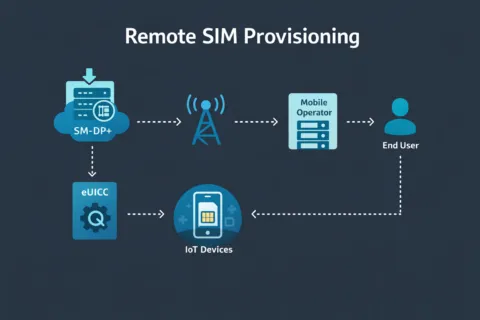
Remote SIM provisioning manages the lifecycle
Remote SIM Provisioning (RSP) is what makes eUICC possible. It relies on two core functions:
- SM-DP (Subscription Manager – Data Preparation): Creates, stores, and securely delivers operator profiles to the device.
- SM-SR (Subscription Manager – Secure Routing): Manages profile lifecycle, including enabling, disabling, swapping, or deleting profiles.
Here’s what the process looks like:
- The device connects using the bootstrap profile.
- Device requests an operational profile.
- SM-DP delivers the profile securely.
- SM-SR activates and manages the new profile.
eUICC is available in multiple form factors
Enterprises sometimes assume eUICC is limited to embedded MFF2 chips. In reality, eSIM eUICC is available across different SIM form factors, including removable cards. This flexibility supports both new IoT products and retrofit projects.
Where standards are going with SGP.31 and SGP.32
The early eSIM standards (SGP.01 and SGP.02) introduced the idea of remote provisioning but created complexity for enterprises.
The GSMA has since developed new standards, SGP.31 and SGP.32, to address those limitations and make large-scale IoT deployments far easier.
Why did the industry need new standards?
Enterprises struggled to adopt eUICC at scale under the original model because switching operators required technical coordination, heavy integration, and slow processes.
As well, IoT devices with long lifecycles, limited interfaces, or strict power constraints needed a simplified provisioning approach.
What does SGP.31 introduce?
SGP.31 defines the technical architecture for a new IoT-focused provisioning model.
It sets the foundation for more flexible connectivity management by reducing the complexity of how devices communicate with remote subscription managers.
What SGP.32 delivers
SGP.32 builds on SGP.31 and brings practical improvements for enterprises:
- Simplified profile downloads for constrained IoT devices.
- Reduced overhead in switching operators and updating profiles.
- Easier large-scale deployments with less dependence on manual operator processes.
Why does this shift matter for enterprises?
Together, SGP.31 and SGP.32 finally open up the eSIM eUICC ecosystem for IoT. Enterprises can:
- Deploy devices faster, without heavy custom integration.
- Switch operators more easily to control costs and ensure resilience.
- Scale deployments across industries that previously avoided eUICC due to complexity.
These new standards create the foundation for next-generation capabilities such as the IoT eSIM Manager (eIM) and IoT Profile Assistant (IPA). They also ensure enterprises gain both flexibility and security as IoT connectivity expands globally.
You can get into more technical details with our SGP.32 explained blog.
Comparing eUICC to traditional SIMs and multi-IMSI
Enterprises exploring IoT connectivity often ask whether eUICC SIM is essential, or if alternatives like traditional SIMs or multi-IMSI can do the job.
Understanding the differences helps clarify where eUICC stands out and where combinations make sense.
How eUICC improves on traditional SIMs
Traditional SIMs bind a device to one operator. Switching operators requires a physical SIM swap, which creates major challenges when devices are deployed in remote or global environments.
eUICC eliminates this constraint:
- Multiple profiles can be stored and managed remotely.
- Operator switching happens over-the-air without touching the device.
- Enterprises gain flexibility and avoid operator lock-in.
How does eUICC compare to multi-IMSI?
Multi-IMSI SIMs preload multiple International Mobile Subscriber Identities (IMSIs).
This allows a device to switch between them quickly, as if it had multiple carriers built in.
- Strengths of multi-IMSI: Very fast switching, strong local coverage, and cost optimization. Particularly valuable for LPWAN networks like NB-IoT and LTE-M.
- Strengths of eUICC: Dynamic lifecycle management, the ability to download, add, or remove profiles over time, and long-term flexibility for evolving deployments.
Why enterprises often combine eUICC and multi-IMSI
Many global IoT strategies use both technologies together:
- Multi-IMSI ensures immediate resilience and fast switching.
- eUICC provides long-term flexibility to download new profiles and adjust to changing needs.
- Together, they deliver true global reach with local optimization.
Only a few providers can deliver both technologies seamlessly. BICS stands out by offering this combination through its IoT eSIM Hub.
Enterprises benefit from optimized coverage, resilience, and cost efficiency, without the complexity of managing fragmented solutions.
What to consider when you’re implementing eUICC?
Deploying eUICC SIM technology at scale brings huge benefits, but it also requires careful planning.
Enterprises need to address technical, operational, and governance factors early in the project to avoid disruptions.
Connectivity management changes when profiles switch
Planning integrations upfront ensures that profile changes do not break existing workflows.
Switching operator profiles can impact how devices behave across systems. Enterprises should be prepared for:
- IP addresses and MSISDNs that may change during profile updates.
- Adjustments in billing records and charging systems.
- Shifts in how connectivity portals and APIs integrate with back-end platforms.
Certification and device constraints are important
Not all devices handle over-the-air updates in the same way. Challenges arise particularly with low-power or UI-less IoT devices:
- Limited processing or battery capacity requires lightweight provisioning.
- OTA channels must be reliable and secure, even in constrained environments.
- Certification requirements differ across regions, and devices need to comply with them before deployment.
Clear policies and governance are essential
eUICC is powerful, but without strong governance, it can introduce risk.
Strong governance frameworks ensure that connectivity remains controlled, secure, and transparent.
Enterprises need to decide:
- Who has the authority to trigger a profile change?
- How will auditability be maintained across profile updates?
- What rollback procedures exist if a new profile fails?
Top use cases of eUICC in IoT
The flexibility and resilience of eUICC SIM technology make it suitable for a wide range of industries.
From global logistics to critical healthcare, enterprises can achieve reliable connectivity without being locked to a single operator.
Use case #1: Cross-border fleet and asset tracking
Transport and logistics companies need vehicles and containers to stay connected across multiple regions.
eSIM eUICC allows dynamic switching to local operators, ensuring continuous tracking and avoiding roaming surcharges.
Use case #2: Smart utilities with long lifecycles
Utility meters and energy infrastructure often remain in service for decades.
eUICC ensures devices can adapt to operator changes or network sunsets without costly on-site interventions.
Use case #3: Manufacturing and OEM deployments
Original equipment manufacturers (OEMs) can embed the eUICC SIM directly into products during manufacturing.
Devices then activate the right local profile automatically when shipped to different markets.
Use case #4: Secure payment terminals
Financial services demand strong compliance and uninterrupted service.
eUICC allows payment terminals to switch operators when networks are unavailable, keeping transactions secure and reliable.
Use case #5: Healthcare devices requiring constant uptime
Connected medical equipment depends on reliable connectivity for real-time monitoring and emergency services.
eUICC provides resilience by enabling multiple profiles and seamless switching if one network fails.
Use case #6: Connected industrial assets
Heavy machinery, robotics, and industrial sensors often operate in global supply chains.
eSIM eUICC enables flexible connectivity that adapts to diverse geographies and regulatory requirements.
FAQs
Is eUICC the same as eSIM?
No. eUICC is the software and infrastructure capability that enables multiple profiles and remote provisioning. eSIM is the marketing term often used to describe an eUICC SIM.
Do I still need eUICC if I already use roaming?
Yes. Roaming provides coverage but not control. eSIM eUICC allows enterprises to switch to local profiles, reduce costs, and stay compliant with regional regulations.
Can eUICC and multi-IMSI work together?
Yes. In fact, many enterprises combine the two. Multi-IMSI provides fast switching and strong local coverage, whereas eUICC delivers long-term flexibility through downloadable profiles. Together, they create global reach with resilience.
Does eUICC only work with embedded MFF2 chips?
No. eUICC SIM technology is available in multiple form factors, including removable SIM cards. This allows enterprises to retrofit existing devices as well as design new IoT products.
Why choose BICS?
BICS is committed to making the eSIM ecosystem fully open for enterprises.
Many barriers that once slowed adoption, such as technical complexity and limited flexibility, are being removed through the new GSMA standards and BICS’ technology stack.
Combining multi-IMSI and eUICC for global resilience
Few providers can deliver both multi-IMSI and eSIM eUICC capabilities in a single solution. BICS brings these together through its IoT eSIM Hub:
- Multi-IMSI ensures fast, reliable local connectivity.
- eUICC adds long-term flexibility with downloadable profiles.
- The combination provides enterprises with unmatched resilience, coverage, and cost optimization.
Standards alignment with SGP.31 and SGP.32
BICS is fully aligned with the latest GSMA standards. Our solutions minimize heavy OTA downloads, deliver robust fallback logic, and prepare enterprises for the future of IoT connectivity under SGP.31 and SGP.32.
One platform for complete global control
Through the eSIM Hub, enterprises gain a single interface to manage global IoT connectivity.
It simplifies operations, ensures compliance, and removes the need for multiple fragmented solutions.
BICS is not only delivering solutions that work today, but it is also actively shaping the next stage of IoT connectivity.
Conclusion
eUICC SIM technology is reshaping IoT by providing enterprises with control, flexibility, and resilience that traditional SIMs cannot deliver.
Earlier standards introduced remote provisioning but were too complex for widespread adoption.
The new SGP.31 and SGP.32 standards solve these challenges and open the eSIM ecosystem for IoT at scale.
BICS is leading this shift. Through its IoT solutions and eSIM Hub, BICS combines multi-IMSI and eSIM eUICC to provide global coverage, local optimization, and standards-aligned connectivity management.
For enterprises looking to scale IoT deployments globally, BICS offers the expertise and technology to make it seamless.